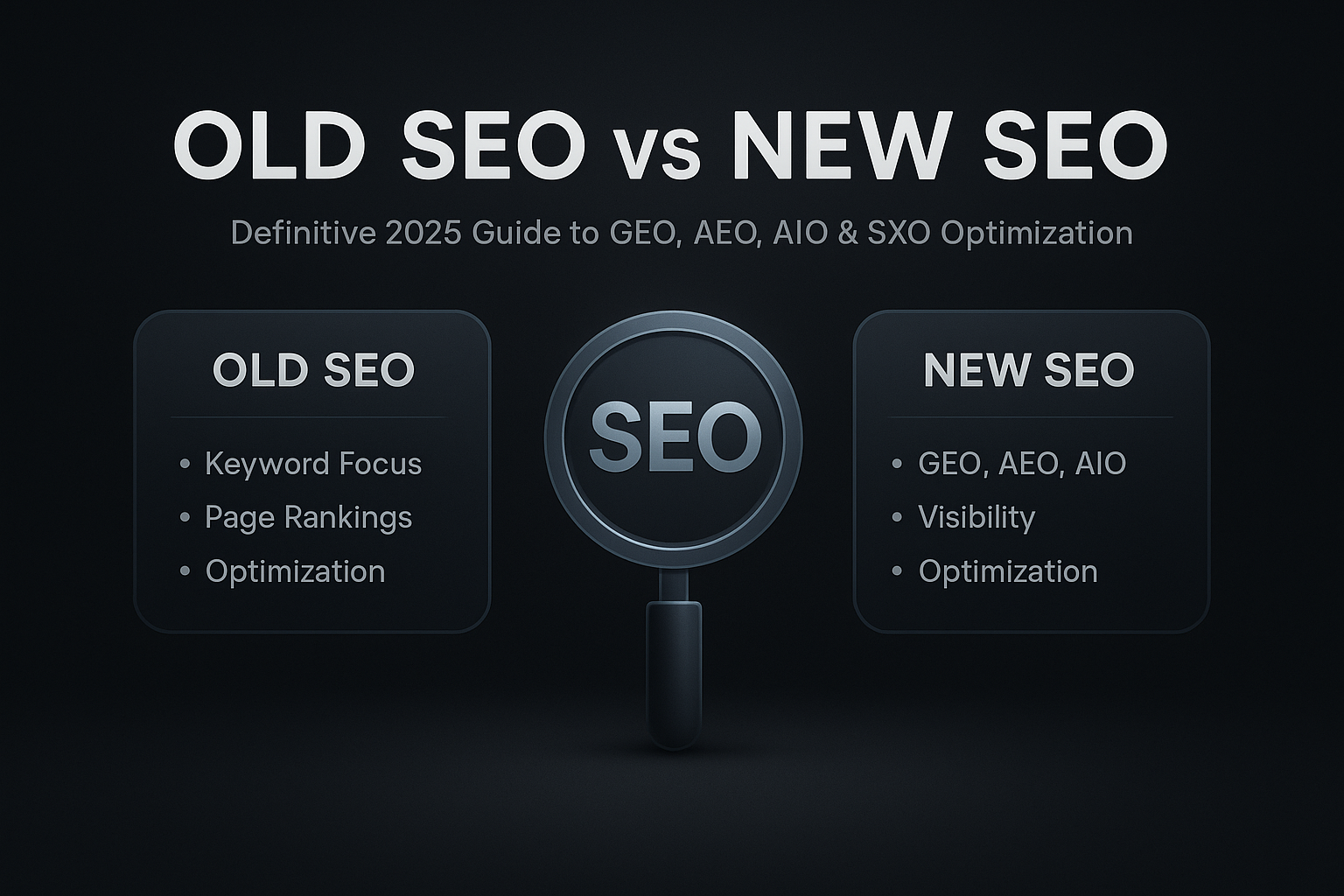
Old SEO vs New SEO: Definitive 2025 Guide to GEO, AEO, AIO & SXO Optimization
The phrase Old SEO vs New SEO reflects the biggest shift the search world has seen in years. We’ve moved from a time when ranking a page on Google was the whole game to a landscape where AI-driven retrieval, citations, and multi-platform visibility decide whether your content is even seen. Search today is spread across traditional search engines, LLMs, answer engines, knowledge graphs, and voice assistants — all interpreting information in their own ways. Because of this, the strategies that once reliably improved rankings no longer guarantee visibility, credibility, or trust.
Instead of focusing only on keywords and backlinks, modern SEO requires content that automated systems can understand, trust, and confidently reuse. It’s not enough to “rank”; your content must be clear enough for an assistant to cite, structured enough for an answer engine to surface, and detailed enough for users to trust. This shift affects everything — how content is written, how it’s structured, how evidence is presented, and how your site communicates expertise.
This guide breaks down that evolution and introduces the frameworks shaping New SEO — GEO, AEO, AIO, and SXO. You’ll learn how each one works, why they matter, and how to implement them step-by-step so your content is retrievable and citable across modern search and assistant platforms. If you want a straightforward, operational look at SEO that goes beyond tactics and helps you build a scalable, future-ready system, you’re in the right place.
What Is Old SEO?
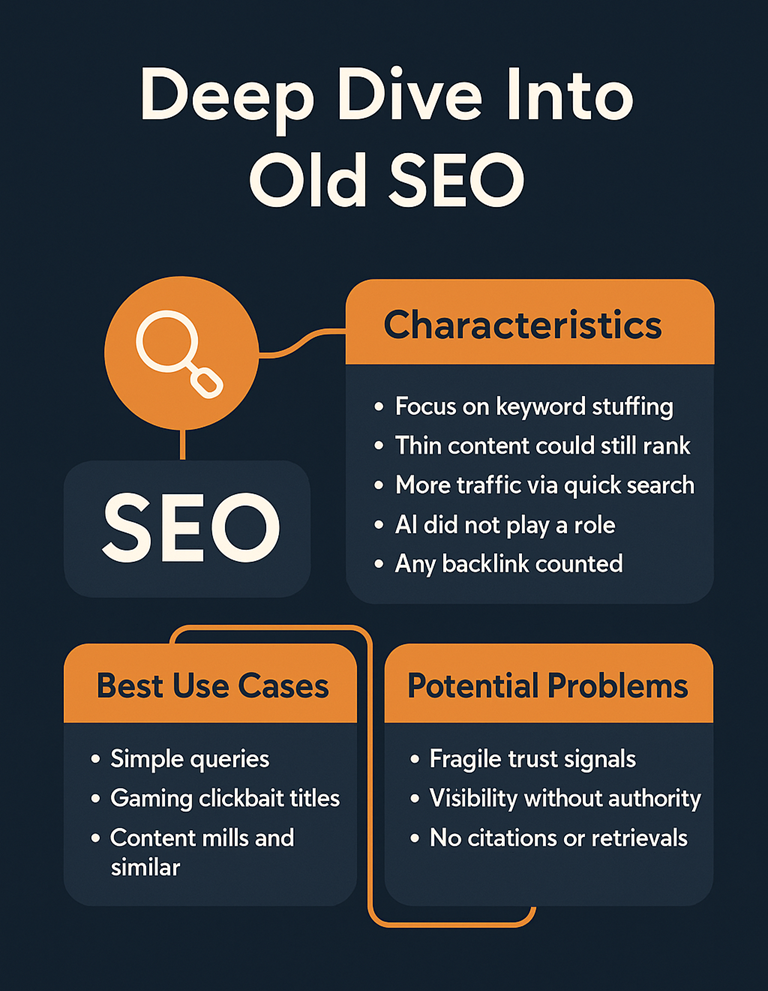
Old SEO belongs to the era when search engines behaved far more mechanically than they do today. Success depended on understanding how those early algorithms measured a page — and then shaping your content to fit those measurements. If you were active in SEO during that time, you probably remember the routine: pick a keyword, repeat it just enough, insert it into the title tag, tweak the H1, create a few supporting H2s, and then build enough backlinks to signal authority. Once those pieces were in place, ranking on page one felt almost formulaic. Businesses loved this predictability because even small websites could outrank established brands if they executed the technical checklist well.
Consider a typical example from the mid-2010s: a small affiliate site offering “best laptops under ₹50,000.” The article might include a keyword-stuffed title, a repetitive introduction, and a list of products pulled from manufacturer descriptions found elsewhere. Yet it often ranked — not because it was truly helpful, but because it matched the keyword and had enough backlinks from outreach. Search engines were tuned to surface pages that matched signals, not necessarily pages that demonstrated deep product expertise.
Another classic example was the rise of article directories and content farms. A business could publish hundreds of short, low-effort articles targeting micro-keywords like “best CRM for salons” or “cheap hosting for photographers,” and each article stood a real chance of ranking because competition was low and algorithms prioritized signal matching over depth. These pieces were often 300–500 words, lightly edited, and rarely added meaningful insight — but the system rewarded quantity.
Link-building worked similarly. Strategies such as link exchanges, private blog networks, and purchased backlink packages often moved rankings because search engines treated backlinks as signals of authority. Over time, algorithm updates penalized manipulative link patterns, but for a long period those tactics delivered results.
Thin content also flourished. Pages with minimal explanation could outrank in-depth coverage if they had cleaner technical optimization or stronger link profiles. User-focused content wasn’t yet a priority for algorithms, which made the environment exploitative for low-value pages.
Over time, search engines released updates (Panda, Penguin, Hummingbird, RankBrain, BERT) to improve relevance and punish manipulation. Those changes forced many sites to improve quality. Yet Old SEO’s focus remained: secure a higher position on the results page by aligning with measurable signals.
The core limitation of Old SEO was fragility. A single algorithm update could dramatically change a site’s visibility. That volatility demonstrated the need for a model focused on accuracy, clarity, and human value — the shift that New SEO brings.
What Is New SEO in 2025?
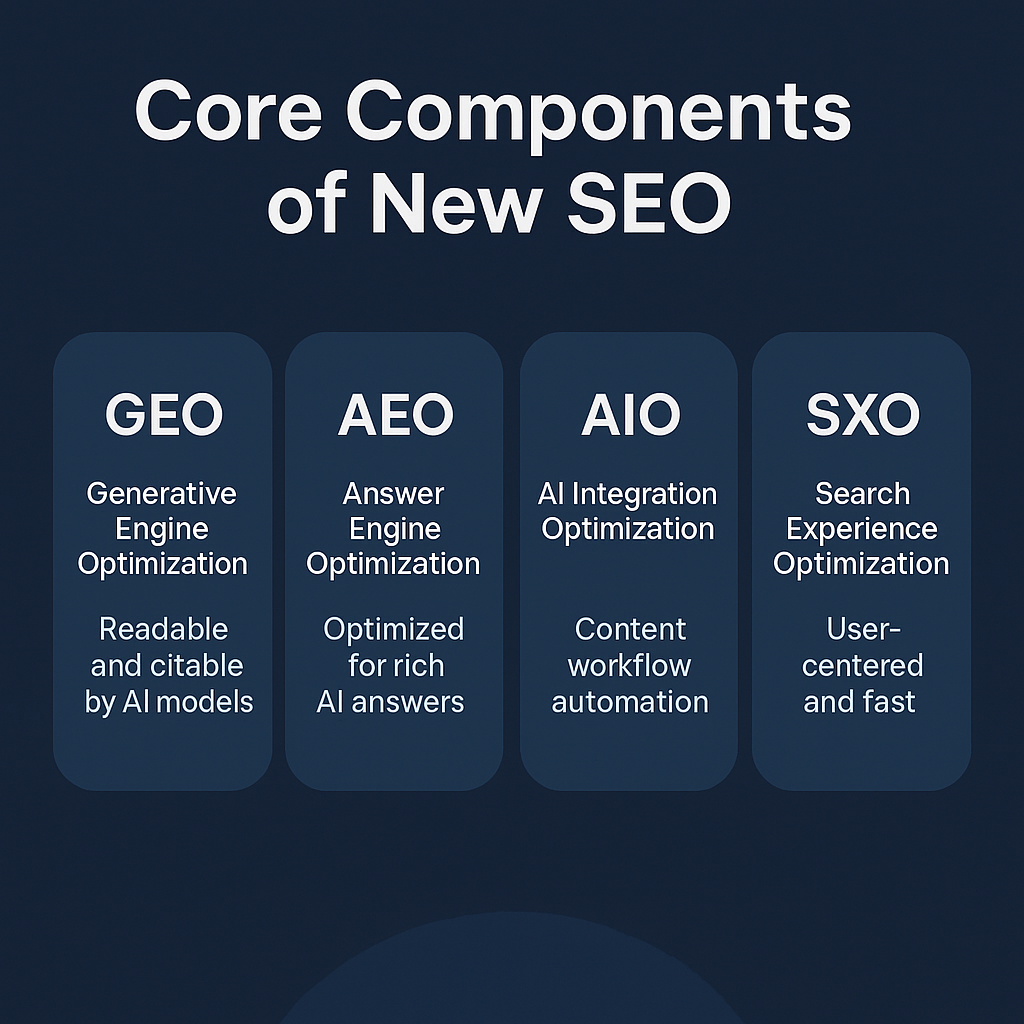
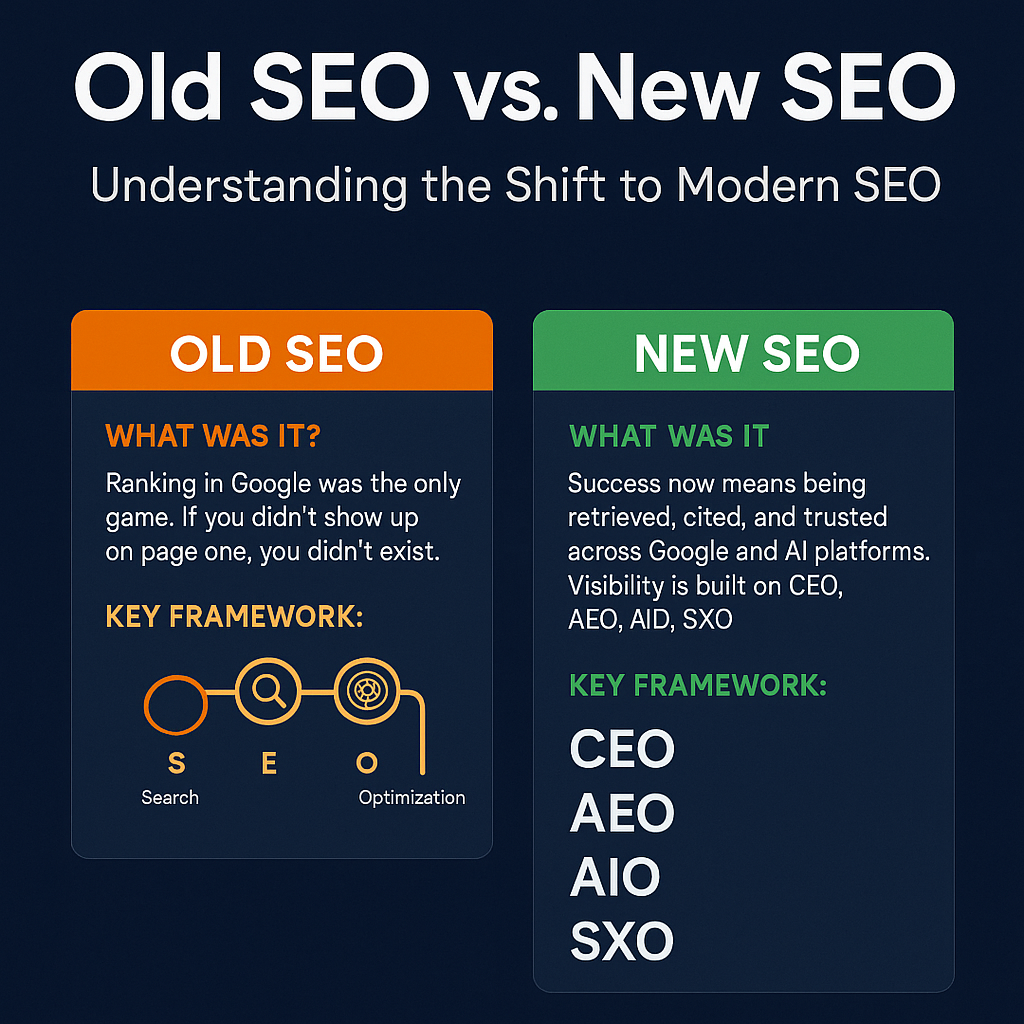
New SEO in 2025 demands more than keyword engineering: it requires content that can be retrieved, cited, and trusted by modern retrieval systems. This means structuring content for answer engines (AEO), generating signals for generative engine optimization (GEO), integrating with AI platforms (AIO), and improving search experience optimization (SXO) to increase conversion and usability.
Core Differences: Old SEO vs New SEO
The most important practical difference is retrieval vs ranking. Old SEO asked, “How do I outrank others?” New SEO asks, “How do I become retrievable and citable across platforms?” This requires trusted data, transparent sourcing, structured content, and signals that prove topical authority. Where backlinks still matter, their contextual trust and citation value now matter more than pure volume.
<label> usage for forms and aria-live="polite" for status messages.
{
  "@context": "https://schema.org",
  "@type": "Article",
  "headline": "Old SEO vs New SEO: Definitive 2025 Guide to GEO, AEO, AIO & SXO Optimization",
  "author": { "@type": "Person", "name": "Ashish Sharma" },
  "publisher": { "@type": "Organization", "name": "TEBSolutions" },
  "datePublished": "2025-11-22"
}
Understanding the New SEO Frameworks: GEO, AEO, AIO & SXO
Generative Engine Optimization (GEO)
GEO focuses on visibility inside generative systems. Generative engines retrieve, summarize, and cite information based on trust signals, authority, structure, and clarity. GEO aims to make content usable by these systems through explicit data structures, factual evidence, contextual relationships, and verification elements that increase retrieval confidence.
Answer Engine Optimization (AEO)
AEO targets systems that provide concise answers. These systems prioritize clarity, brevity, and precision. Positioning content for AEO requires answer-first presentation, clean headings, and schema markup for direct extraction.
AI Integration Optimization (AIO)
AIO ensures content works reliably within automated workflows and agentic tasks. Predictable markup, clear sectioning, and machine-readable structure help automated systems reuse content accurately.
Search Experience Optimization (SXO)
SXO merges UX, content quality, interaction design, and conversion principles. Improve accessibility, layout clarity, and performance to increase engagement signals that support visibility.
How to Apply New SEO Frameworks: A Practical, Step-by-Step Guide
Step 1: Building Retrieval-Ready Content
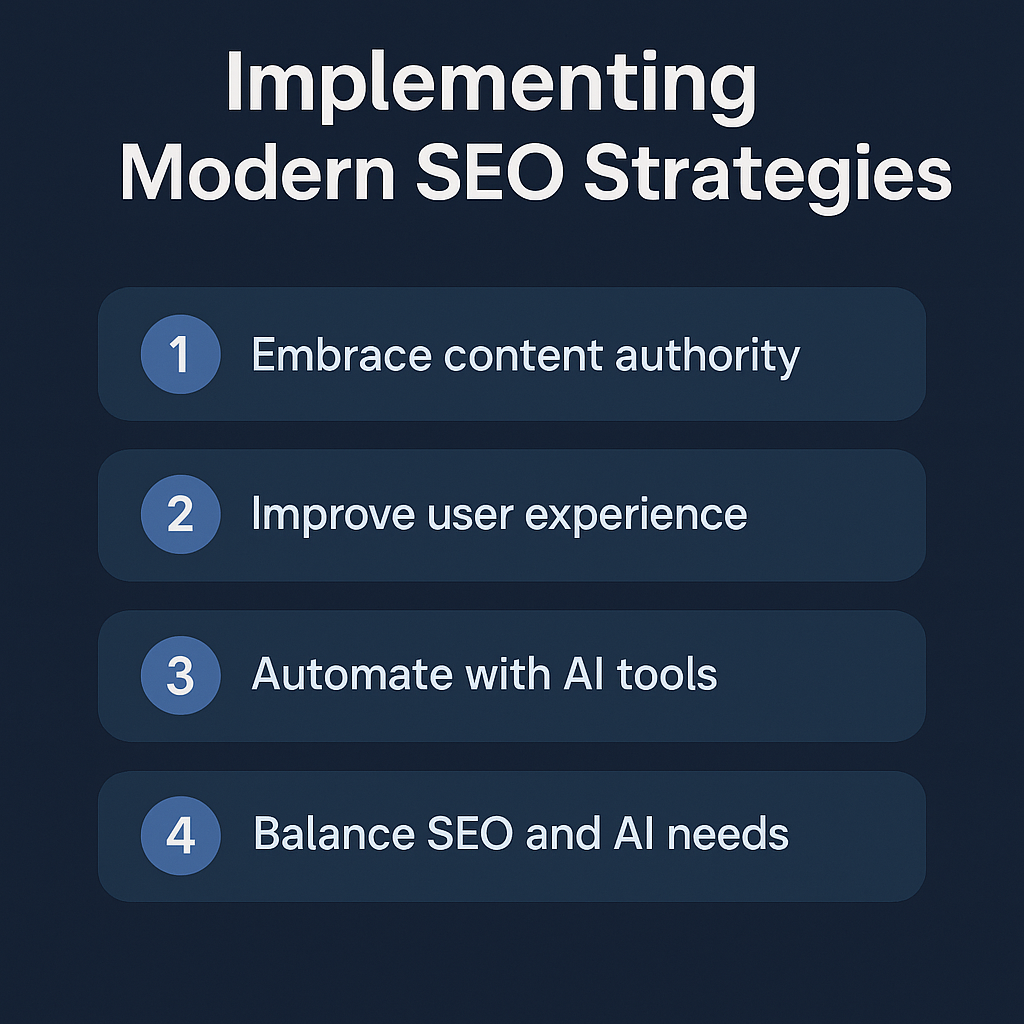
Organize content into clearly labeled blocks, use short declarative sentences, and provide evidence for claims.
Step 2: Establishing Strong Entity Signals
Use consistent terminology, schema, and structured facts to reinforce entity relationships.
Step 3: Schema Markup Best Practices
{
  "@context": "https://schema.org",
  "@type": "Article",
  "headline": "New SEO Guide",
  "author": { "@type": "Person", "name": "Ashish Sharma" },
  "mainEntityOfPage": "https://tebsolutions.in/"
}
Step 4: Answer-First Content
Start sections with direct responses, then expand with context and evidence.
Code Implementation for New SEO, Retrieval, and Technical Foundations
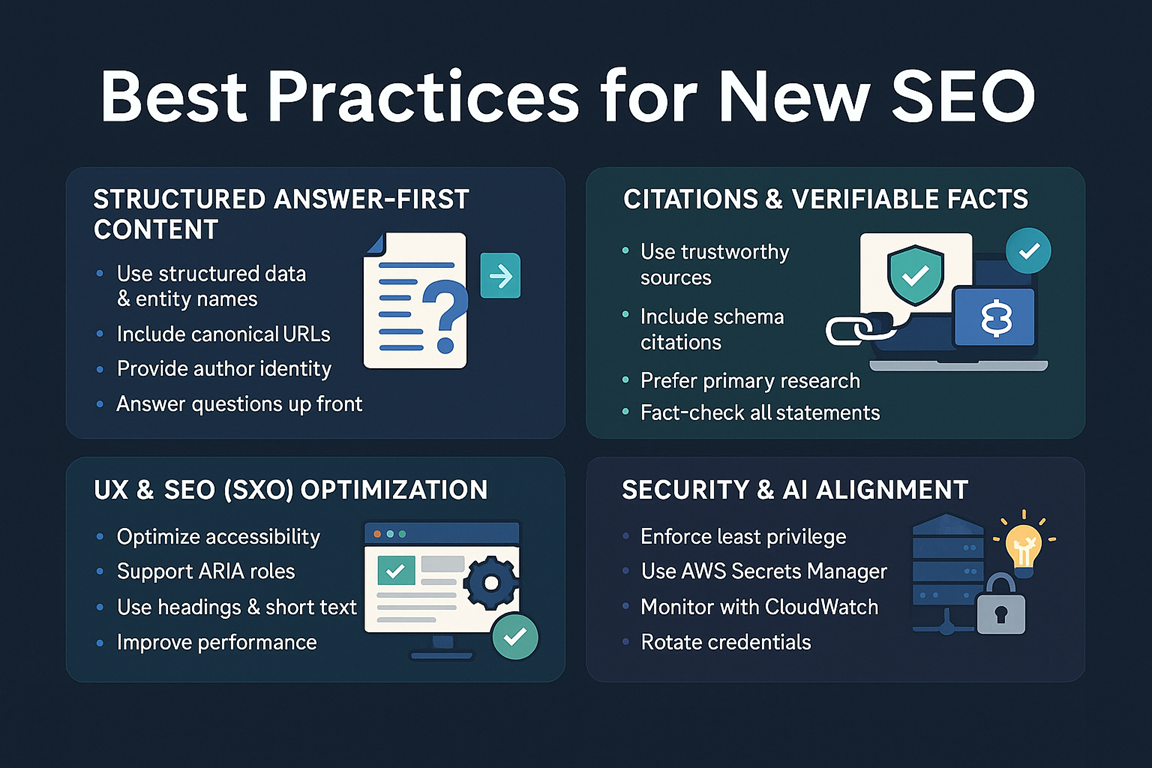
Technical implementation affects structured data, accessibility, speed, and security. The examples below are practical templates for front-end and serverless back-end setups, with production guidance.
<!DOCTYPE html>
<html lang="en">
<head>
  <meta charset="UTF-8">
  <meta name="viewport" content="width=device-width, initial-scale=1.0">
  <title>SEO-Optimized Form</title>
</head>
<body>
  <main>
    <h1>Contact Submission</h1>
    <form id="contactForm" aria-describedby="form-status" novalidate>
      <label for="name">Name</label>
      <input type="text" id="name" name="name" required>
      <label for="email">Email</label>
      <input type="email" id="email" name="email" required>
      <label for="message">Message</label>
      <textarea id="message" name="message" rows="5" required></textarea>
      <button type="submit">Submit</button>
      <p id="form-status" aria-live="polite"></p>
    </form>
  </main>
</body>
</html>
Production note: in a live environment avoid wildcard CORS and configure a strict allowed-origin list. Store secrets in a secret manager and verify email identities before sending.
Best Practices: Operationalizing New SEO at Scale
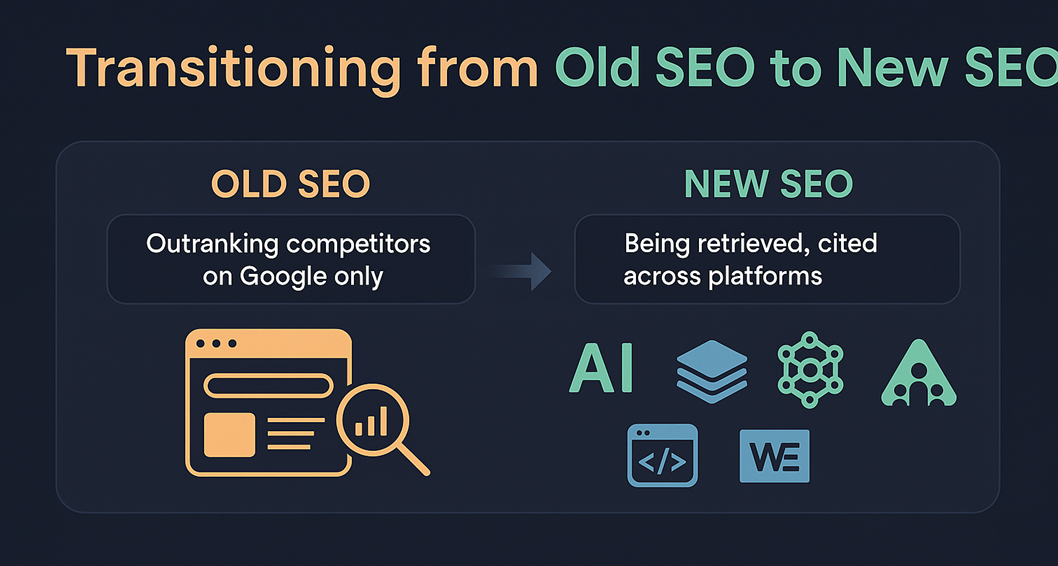
Start with a central content model, use templates that enforce structure and evidence, and run periodic audits for accuracy and schema compliance.
Essential Production Security Notes
- Use domain whitelisting for CORS.
- Avoid logging sensitive user data.
- Use Secrets Manager for keys and credentials.
- Verify email sending domains.
- Grant least privilege to IAM roles.
- Monitor with a logging/observability system.
Conclusion
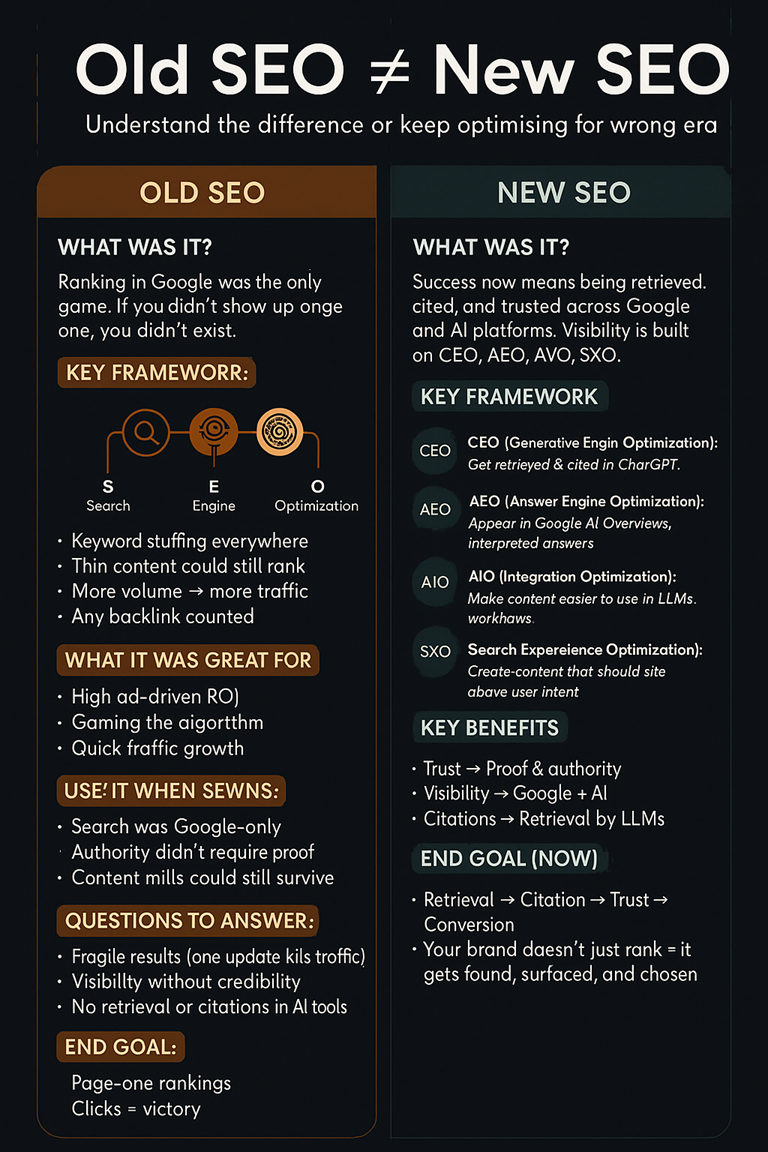
The transformation from Old SEO to New SEO requires moving from tactics to systems. Prioritize clarity, evidence, and experience so your content can be confidently reused by modern discovery platforms.
Frequently Asked Questions (FAQs)
1. What is the main difference between Old SEO and New SEO?
Old SEO focused on keyword ranking and link-building; New SEO prioritizes retrieval readiness, structured data, factual accuracy, and user experience.
2. Why is structured data important for modern SEO?
Structured data provides machine-readable context to support extraction and citation by automated systems.
3. What does GEO mean in SEO?
GEO stands for Generative Engine Optimization and focuses on making content retrievable and citable by modern retrieval systems.
4. How does AEO differ from GEO?
AEO (Answer Engine Optimization) targets concise answer presentation, whereas GEO targets retrieval and citation within generative systems.
5. Is link-building still relevant in New SEO?
Yes. The emphasis is on contextual, credible links rather than sheer volume of backlinks.
6. Why do structured and segmented pages perform better?
Structure and segmentation make it easier for automated systems and users to locate and trust factual blocks of content.
7. How do I optimize for answer boxes and summaries?
Use answer-first paragraphs, short lists, schema, and clear citations to increase the likelihood of being extracted as a concise answer.
8. What are entity signals and why do they matter?
Entity signals connect your content to known concepts and help platforms place your content in the correct topical context.
9. How does accessibility impact visibility?
Accessibility improves user experience and provides semantic clues that support automated extraction and reuse.
10. How often should I update important pages?
High-authority pages should be reviewed quarterly. Refresh facts, update references, and validate schema markup regularly.